After Santa Fe’s ICE raids, what should an immigration evaluation document?
An immigration psychological evaluation can document symptoms and changes in daily functioning when enforcement fears or a family member’s detention affect a household. New Mexico’s limits on local cooperation do not stop federal arrests. Clinical findings require an individual assessment; the attorney determines their legal relevance.
What happened in Santa Fe?
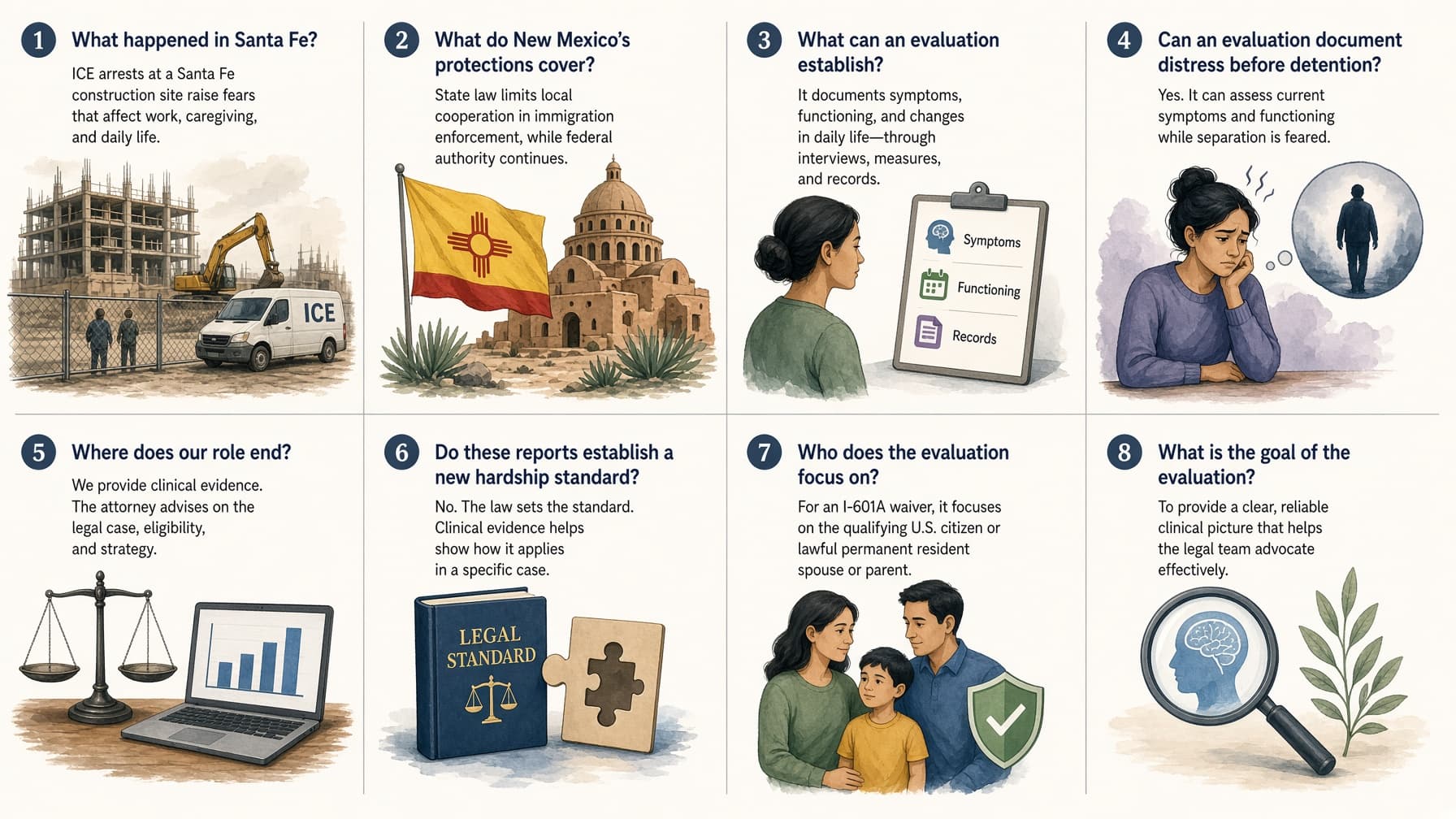
Agents from U.S. Immigration and Customs Enforcement (ICE) arrested several people at the Los Brios housing construction site on October 13. Searchlight New Mexico’s October 14 account also described builders’ concerns about workers staying home out of fear. Federal officials had not answered the reporters’ requests for confirmation and details when that account was published.
Those reports raise questions that an arrest count cannot answer. Has someone stopped working? Who is caring for the children? Has the household lost the person who drives a relative to medical appointments? The answers require information from the people affected.

What do New Mexico’s protections cover?
The Immigrant Safety Act restricts public bodies’ participation in civil immigration detention agreements and agreements that deputize local personnel for immigration enforcement. It governs state and local participation, while federal enforcement continues. Enacted law, Sections 3–4
KRWG’s September reporting describes concerns about cooperation outside formal agreements. Nationally, The Marshall Project’s September 10 analysis documents expanding local involvement in immigration arrests. That national pattern does not establish who participated in a particular Santa Fe operation.
Detention contracts are a separate issue. On October 16, the New Mexico Immigrant Law Center, represented by the ACLU of New Mexico, sued ICE for records concerning contracts involving the Torrance and Cibola facilities. The complaint seeks disclosure under the Freedom of Information Act. It is not a court ruling invalidating those contracts. Source New Mexico reported that Homeland Security was reviewing the lawsuit. Filed complaint, Source New Mexico
What can an evaluation establish?
At Kipu Terra, our work is to assess the person referred for an immigration psychological evaluation, also called a psychosocial evaluation. A news report can describe the surrounding events. It cannot establish that person’s symptoms or explain every change in the household.
We ask about sleep, concentration and the ability to manage daily responsibilities. We establish when a reported change began, how often it occurs, what was happening beforehand and whether other circumstances may explain it. A missed workday, a change in caregiving or difficulty attending medical appointments needs its own account and, where available, supporting records.
Interviews, standardized measures and records each contribute different evidence. The evaluation distinguishes what the person reports from what the evaluator observes and what documents support. A report should also state the limits of the available information. Fear alone does not establish a diagnosis.

The legal case determines whose hardship is relevant. For an I-601A waiver, our evaluation focuses on the qualifying U.S. citizen or lawful permanent resident spouse or parent. Other case types require a different assessment. The recent arrests do not make one evaluation format appropriate for every family. USCIS Form I-601A, Part 4
Where does our role end? The attorney advises on arrest, detention, eligibility and filing strategy. We provide clinical evidence. An evaluation cannot prevent an arrest, secure release or guarantee an immigration decision.
We provide evaluations nationwide through secure video, with interviews in English or Spanish and professional interpretation for other languages. Our I-601A evaluation page explains the assessment of a qualifying relative.
Related evaluations
Common questions
- Can an evaluation document distress before a family member is detained?
- Yes. It can assess current symptoms and functioning while separation is feared. Any discussion of future effects must be distinguished from findings about the person’s present condition.
- Do these reports establish a new hardship standard?
- No. The articles describe enforcement and detention developments. The attorney identifies the applicable legal standard and determines how clinical evidence fits the case.
Sources
- Searchlight New Mexico, October 14, 2026Reporting on Los Brios arrests and builders' accounts of work absences.
- New Mexico Immigrant Safety Act, Sections 3–4Statutory restrictions on public detention and deputization agreements.
- KRWG, September 24, 2026Reporting on enforcement exposure outside formal cooperation agreements.
- The Marshall Project, September 10, 2026National analysis of local participation in immigration enforcement.
- New Mexico Immigrant Law Center v. ICE, filed October 16, 2026Complaint seeking production of contracting records under federal disclosure law.
- Source New Mexico, October 16, 2026Reporting on the lawsuit and Homeland Security's response.
- USCIS Form I-601A, Part 4Identifies the qualifying U.S. citizen or permanent resident spouse or parent.
Disclaimer. AI was used for generating neutral illustrative images that complement and flow with the article.
This article provides general information, not legal advice.